Monday, December 13, 2010

Group Project Response


Although I tend to be more interested in how the brain determines our interactions and adapts to various aspects of society through psychology and neurology, I found research through sociological resources to be more appropriate.  Much of the time we spent together, it was to discuss the idea of “community” and discovery of each individual within the group.  Throughout the course of three weeks, we meet in various group patterns, such as two individuals for dinner or three that walked together.  Finally, the whole group met together for a lunch that was later repeated as a performance in class.     

To begin, the idea of “community’ is a good warm word frequently invoked by citizens, social workers, and politicians”.  This is something that humans desire to create a justification or even gratified experience toward the idea of belonging cooperatively to a society.  Customs and patterns of behaviors within a society not only serve as a ritual, but determine the social order.  Through the breakdown of these patterns, “society,’ [can become]… more ambivalent, invoking something elitist and exclusive.”  This leaves the “‘individual’ [to] often connote selfishness and bracketed with society” (Tuan).  Upon these different layers, I found applying them to our project can create various perspectives on how to understand what I saw as the collective underlying human condition through community, society, and the individual.

Community could serve on a national, even global platform, but for the organization within the group, it served as an educational system that determined our interaction as one unit.  Second, the society or culture built upon the materials for which we individualistically collaborated into one performance.  As individuals, we recognized different ritualistic patterns.  To serve as one community, the individuals were forced or willing subjected to perform in one instance.  These materials help to define the ritual of eating that was centered on the table or as it was in medieval times, the trestle table.            

The individual gives a light into what Tuan referred to as a view of “the existence of the world [held] within each character.”  Although society can build different meanings of the individuals as they individual is often seen as the break from the cooperative whole.  Complications can arise when society is to analyze to what extent the individual’s behavior breaks social order, whether it could be considered individualistic or deviant.  Overall, the project brings to question sociological ideas about our society that could be explored further.    

Tuan, Y.-F. (January 01, 2002). Community, Society, and the Individual. Geographical Review, 92, 3, 307-318.

Sunday, December 12, 2010

AMHA: Crocs PetPeeve

This is a pretty straight forward installation. I line the sole of the crocs with pink bubblegum. The contrast of the Dark Blue crocs and the pink, I thought was most effective in showing my playful but true annoyance with crocs. The gum speaks to how crocs litter the boulder pathways with their artificial material and how they leave an irritating, sticky feeling to me.  
AMHA: Mask

The title says it all. Most of my personality is a mask and a false front. Having many thoughts, emotions and repressed feelings behind this mask, it allows me a false sense of belonging and acceptance in the world. It is made out of journal pages from my self-inquiry. Journaling is a tool for me to get beyond my mask self, and to look at the Divine as well as the evil that exist within myself. In seeing the truth about myself clearly and allowing others to see it as well, I feel is the only meaningful way to be. By creating cone shapes out my Journal pages I allow the viewer a portal into myself beyond my mask. They are allowed a glimpse beyond the imaginary front that I present to the world.
I was happy by the way it turned out, although I did not intend for it to be scary. But I later realized this scary repulsive image of my mask, is what believes to be protecting me from painful truths. I felt it was an accurate representation of defensive withdrawal, false superiority, intimidation and pride.

AMHA: Lightsteps

This installation speaks of a universal journey that everything takes towards realizing it’s true nature.  Being my first official installation work, there are many synchronicities with this new path I’m walking as an artist. I feel this symbolic representation of footsteps and candles leading down the cold concrete stairwell of the art building, is also easily relatable to other viewers. My intention with this installation was to inspire a remembrance in the viewer of their true nature. I hoped as students rushed by busily thinking of their next step, they would be confronted by deeper questions regarding their journeys. Where is it that we are going, and why? What is it that leads us to do what we do? For whom are we doing it? Is it for our selves, for money, for others, for recognition, or simply for the joy of it? Each must answer these questions for themselves and are free to interpret this installation from their own personal journeys. For me, it is a dedication to the holiest place inside all of those who have shared their wisdom and guided me on this lonely path.  It is dedicated to the imprints of light of others, that I take refuge in. It was especially inspired by an encounter with a beloved teacher, who has lit up my path towards love, light and my true nature. 
Besides not being able to light the candles inside the building, I thought this piece was a success. I would have liked to install a really long trail throughout the whole building or even outside. 


Saturday, November 13, 2010

Farsi Lesson- By Jenna M. Montazeri

My husband's first language is Farsi. Mine is English. Although he is fluent in English and communication is never an issue, the idea of sharing something that is near and dear to his heart is always a desire. He comes from a culture that is so deeply rooted in poetry and beauty, and I long to go through that portal of language to understand his heritage more deeply. But, alas, language- any language- seems unattainable and distant. Sometimes the words just seems like sounds with no meaning attached. It is hard for me to remember. Hard for me to let it sink in. And I always end up at square one- usually the alphabet.

In this piece my husband and I sit down for a lesson in Farsi. We both face the individual cameras that are recording us so that it is easier for the audience to relate to each one of us on a seperate level. The frame is tight on our faces, and we interact with each other at times so that there is an established relationship while still feeling isolated in our own frames. With this piece I wanted to explore the playfulness, the excitement, the awkwardness of the sounds, the frustration and the duration of learning this language all at once. I am working on the edits on the piece to make it flow a little better. Your thoughts are appreciated.

Monday, November 8, 2010

@#*$&^!=I'm mad you.

The voice program that I used was the best I could find with some intonation in it.  A Japanese friend had wanted to learn British English versus an American accent, so I had found this program to assist him in pronunciation.

For this project, I was inspired by my Internet friends to create this piece as many Japanese couples don't have children and only have each other to deal with.  There were severals times in particular that my friends would begin arguing while talking to me on Skype or MSN Messenger and try to outdo each other in embarrassing one another.  We saw this material as being appropriate for discussing relationships and married life in American culture.    

My collaborator was also interested in this topic as we had created several other works together in the past. She was interested in the viral aspect of the Internet in relation to "life on the net."  Socializing online becomes another life that is separate from our own.  Our interests and behaviors can adapt and change to virtual space.

While researching another performer, Michael Smith, I was interested to find that his concept was about individuals trapped within a media-saturated society.  At first, I related his idea to the Internet, but was a little surprise to find that he was talking about television.  After seeing the timespan for which he had began creating works, I realized that the Internet was not widely accessible to the public during those times.  I was inspired to see this connection between the influence of television and commercials to the power of the computer in our time.

Technology does tend to make things more difficult as our previous sessions had went more smoothly.  The delay and length of the piece both need to be shorten.  As I see, most performance artists who use deadpan humor, I think keeping the performance brief is key.  With shortening the piece and adding a structured outline and punchline for the piece, I think it would become a funny commentary.  Overall, I wasn't feeling very creative that week, so being able to break through and work with this performance was very inspiring.

Saturday, November 6, 2010

The Breath Beneath


The Breath Beneath. I have decided to leave all extra music out at this point and would appreciate your thoughts on the new version. http://www.vimeo.com/16443523 This piece is one that explores the past, present, and future and how the memories from the past are held in our bodies influencing the present and the future. I find this understanding displayed through images of being under the surface and moments of being above as well as the few moments that the camera allows the viewer to experience both simultaneously. I really enjoyed the sounds that the camera makes and was playing with the edits to create the sound score simultaneously. I feel in someways I used Yann Tiersan as an additional element that could connect the piece together and it is possible that I didn't need that. Given my dance background I tend to rely heavy on the music and find my self in my video work doing the same. It is helpful for me in the editing process but just as I like to used music to choreograph I also like to change or drop the music all together for the final version. It is interesting to see how choreography crosses over into editing as well as the editing process into choreography. I think it is spellbinding how most thought the footage was 8mm and how everyone assumed the old footage was actually of my family. I used an underwater digital camera for the footage of myself and all other beach footage was found. I did find myself drawn to moments in the found footage that reminded me of my family and so in some ways I was still maintaining the spirit of my personal memory through anothers actual experience. The moment when the mother realizes the camera is on her she tries to hide herself and that is something my mother would constantly do if she realized she was in the shot.

Thursday, November 4, 2010

a novel

With one book and VHS tape, I wanted to test limiting my materials while combining a performance within an installation.  The overall intent of my piece was to relate what I see as abstract layers of obsolete materials and feelings through the death of self, technology, and language.  Hard copies of books and tapes are becoming obsolete with the advancement of digital technologies.  I associate the same feeling while studying literature.
The book used within the piece was Natsume Soseki's Kokoro, which is becoming more and more a fragment of the past.  This is becoming especially apparent when the image of this prized author was removed from the front of the 1000 yen banknote in 2004.  In accordance, a performance is only temporary.  It is subject to becoming obsolete in a quicker process than a painting or drawing.  The remnants left behind serve as the nostalgic essence of that performance and a new work.  Additionally, this obsoleteness carries into and hides our insight into our past versions of our self and their perceptions.
The question I wanted to explore is if we are able to break into that trap and reveal what is hidden or does that information simply corrupt with the passage of time.
For future pieces, I would like to explore this relation and create new pieces through different combinations of my previous works.


Wednesday, November 3, 2010

De-escalating Anger Management (DAM)

The skeleton of of the DAM theory is simple yet very complicated and although extremely beneficial to those who practice, not something to be taken lightly. I believe that I have been chosen to share this knowledge with you all in hopes to bring understanding to your lives. I have a special gift from God that allows me full confidence in my ability to teach the DAM theory. In order to understand the DAM theory one must first go to the pyramid. I bring up pyramids because looking back at history we can all agree that it is through the pyramid we see the birthing of many great things. So if you can imagine a pyramid or what others think of as a triangle, an up side right triangle with three corners, the bottom left corner is where the (D)De escalating sits, the bottom right corner is where (M)Management sits and the tip top of the pyramid is where (A)Anger sits. In this pyramid ANGER is the ruler. So say for example . . .you ask the hostess if you and your significant other could sit at the bar and eat breakfast and she looks at the bar and says, "If you can find a place." Already you don't like her tone. You are looking at the bar and yeah it looks crowded but you could probably squeeze in somewhere. Your starting to get furious because this hostess doesn't want to help you. You take it very personal. She is supposed to help you. You deserve her to treat you well. STOP, in this moment I step in. I am not here to validate if you are right or wrong in feeling anger. I am here to invite you into your anger and allow you to fully experience what this anger would look like. In this moment of fully experiencing your anger you take your hand and make a gun like gesture and pretend you are going to cap her. In the middle of the first cap you draw back you start flapping your arms getting faster and faster. You are halfway to safety, you have just made the first step in transitioning your anger into an animal. From here you fully embrace the animal by pulling out all your bird sounds and continue jumping and flapping your arms. Then inspired to create by your anger you turn your animal into a dance move. Your bird begins to transform into a side slide allowing your arms to continue going out and in as you slide side to side and suddenly with out effort you begin to smile. You crossed over from (A) Anger through (D) De escalation to (M) Management. It is real and it works!! You now find yourself thanking the anger for bringing you to this new enlightened place through movement. This my friends is how the DAM theory works. Please take note. . Coming soon. . www.thedamtheory.com My website will offer great advice as well as some spellbinding animal moves derived from deep seeded anger gestures (i.e the punch or the high kick to the face) that can lead into great dance moves. Also be on the watch for personal success stories. I must say these stories continue to inspire me and validate me as a human daily as I continue to access the DAM theory on an hourly basis.

Sunday, October 24, 2010

Preacher's Victim

Preacher's Victim by Matthew Whalen

In the piece Preacher’s Victim, I explore the insecurities of my religious and spiritual beliefs and the changes I’ve undergone since I left home. Raised and confirmed Catholic, after leaving for college three years ago, I denounced my religious ties and have been searching for a spiritual home since. The piece consists of a radio-broadcast reading of the prologue to The Satanic Bible, backed by a classical hollywood score from the film The Sea Hawk to give an older broadcast feel. Also accompanied with a scratch film of a cross transforming into a pentacle, the installation explores the vulnerability of a faithless soul, searching for a religion to call home.


Over the past couple weeks, I’ve been listening to a lot of radio, stumbling across radical Evangelical broadcasts preaching to the faithless masses in Colorado. The point of these radio shows is to hail subjects, instilling ideologies in hope of gaining more religious followers. Conflicting ideologies attack our senses everyday and the radio is a classic medium of the 20th century to express religious views to the masses. I feel a vulnerability, but don’t necessarily respond to the radical preachers on the radio. I’m in a point of limbo, where I can fall subject to some hailing faith or ideology. The film shows this transformation, where my past affiliations change over time. On the other hand, the satanic broadcast is the origin of this transformation, taking advantage of the faithless listeners on the radio. I want to work with a larger space, maybe create a living room setting where these religious ideologies seep into the home. The film could project from an older TV and the radio broadcast rhetoric could be more concise. Continuing with this theme of religious vulnerability, I want expand this idea to a larger setting and maybe have a multitude of religious ideologies attack the viewer.

Still Life Photography Demonstration


Still Life Photography Demonstration- Jenna Maurice Montazeri

What happens when you watch old home movies... and you realize that your sister always had to follow the act of you- the loud, too perky, too conversational, overly dramatic little sister. My sister Sara and I grew up together and it is only just recently that I have been exploring the strange dynamic of our past. While watching a home movie I discovered a scene involving both of us competing in a "demonstration contest" at our local 4-H club where we had to demonstrate our knowledge of a certain subject matter, as well as demonstrate pose and public speaking ability. I did my demonstration on "The Five Food Groups"- a subject that was easy enough to chat about and make it look like I knew what I was taking about. I even planted a questioner in the audience to ask me "which food group tomatoes were a part of" so that I could show how knowledgeable I really was and let them know that, contrary to popular opinion, they were fruit. Sara, my older sister, followed my "act" with a demonstration about "Still Life Photography"- a subject she had apparently been reading about in a book that explored the topic much like a book about installing a new washing machine- very mechanical.

Sara performed her demonstration with shy eyes and head down. She didn't have the confidence in her subject matter to be completely sure of what she was demonstrating. There was hesitancy, but there was courage. I wanted to be her in that moment.

With this history in mind, the performance was not what I had thought it might be for me. Being in a room full of artists who know that the rules set forth in her demonstration are a bit ludicrous, the performance just ended up being farcical- and it was hard for me to keep a straight face at times. Looking back on the performance, I see it as just another way that I garnered attention- by "stealing" her perfectly (now) amazing demonstration and using it for my own selfish gain. A perfectly good intention now turned to something a bit tainted from the original thought.

I still think the performance was successful on a certain level. The irony of it is intriguing to me. I think I am still processing through it. Any thoughts would be appreciated. Since none of you knew the background, I wonder what your reactions to the piece were?

performance & installation arts 5104/4104: Grace Notes

Commentary works really well as an introduction to this fine piece. Sounds good on line - I kept it running while I worked - soothing and moving too. Nice work, Nick

Friday, October 22, 2010

Grace Notes


GRACE NOTES by Nicholas O'Brien

The score for this performance used appropriated + cut up samples from traditional Irish folk music and recording samples of my singing mixed live to create a rich texture of sound. After arranging the loops of the recordings and getting these in a kind of synchronicity, I then began to sing along with the recorded audio through a couple of different analog manipulating devices (pedals).


The performance and process of editing and appropriating from this folk music was an attempt to shorten some distance I feel with my Irish heritage. Three years ago I had taken some time to read a good amount of contemporary and canonized Irish literature and found that my own work unconsciously addressed very similar themes. I felt as though I should deliberately address some of these similarities, and explore how to connect my practice directly with some folk traditions in Irish culture. By choosing to go through these mediated and technological devices, I intended to make a gesture that spoke to the comfort and security I find within and around the web and network societies.

Grace Notes


GRACE NOTES by Nicholas O'Brien

The score for this performance used appropriated + cut up samples from traditional Irish folk music and recording samples of my singing mixed live to create a rich texture of sound. After arranging the loops of the recordings and getting these in a kind of synchronicity, I then began to sing along with the recorded audio through a couple of different analog manipulating devices (pedals).


The performance and process of editing and appropriating from this folk music was an attempt to shorten some distance I feel with my Irish heritage. Three years ago I had taken some time to read a good amount of contemporary and canonized Irish literature and found that my own work unconsciously addressed very similar themes. I felt as though I should deliberately address some of these similarities, and explore how to connect my practice directly with some folk traditions in Irish culture. By choosing to go through these mediated and technological devices, I intended to make a gesture that spoke to the comfort and security I find within and around the web and network societies.

Thursday, October 14, 2010

A Short Narrative by M. Taylor


The inspiration behind A Story Narrative by M. Taylor was built upon a combination of character development, humor, and the contrast between confessions and lying.  While I’ve been exploring the function of internal and external perceptions, I intended to focus on the flow of consciousness versus its confliction in a given environment. 
An interesting idea I found while researching other artists’ is the idea of adapting to your studio environment and allowing that to influence the creation of your work.  Margaret Crane and Jon Winet, a collaborative pair, commented upon their acceptance into a residency with Xerox’s PARC Program that they didn’t need to rearrange their studio space, because it would be like going to a foreign country and only experiencing their own culture.  Therefore, I want to give into the characteristics of our classroom environment, such as the dimming lights, the movement of sound, and adapting to the awareness of other’s works that have entered and left the space. 
For character development, I created the structure of their behavior, reactions, and speaking patterns.  Within the environment I wanted to influence and adapt to the character’s behavior by setting up props.  Then, the character was free to act out.  An aspect of their behavior that wasn’t strongly seen was how the character was consciously taking from other’s projects.  I intended for the audience to recognize the references to other’s work, such as combing the hair, emphasizing on “living,” and quoting pop culture with “the pickles.”

Following the development, there is a specific process I find that I go through.  After I know the language of the character, I begin listening to them as I imagine the character talking to me.  After thinking about the possible conversation that we would have, I force myself to only think in their character voice.  Next, I let myself begin to "think out loud" and talk to myself.  I allow my voice to adjust to the characters'.  I don't begin to interact with others until I feel comfortable with the character's voice and it has begun to sound like the voice I imagined.  I feel that the behavior and body language of the character will become natural only after the thought process and voice of the character is achieved.

Overall, the humor and props were the most helpful in the development and performance of the piece.  I would like to explore the use of props more and going further into character development, such as exaggerated facial expressions.  


Saturday, October 2, 2010


A call and response performance by Nicholas O'Brien and Kari Treadwell.


For this performance, Kari and I gave ourselves a very simple instruction set: follow the sound and motion of Kari's tap dancing with my hands. We resolved to dress as similar as possible to avoid any external visual influence. In order to get the most out of the volume of our movements, we decided to both perform on wood planks. Not only was this decision motivated by sound, but it also points towards a traditional history of tap dancing that we both felt was a strong part of the performance. Although we haven't explicitly planned any future performance, we have discussed how our own personal ancestries play a significant role in how we want to explore our bodies, our voices, and our actions. We felt that the location for this performance was well suited for the sound we wanted to create; a rhythmic and cacophonous space where initiator and performer (ie Kari and I respectively) would blend into one sound as the performance developed.

Thursday, September 30, 2010

Wouldn't it be nice if everything was the way it's supposed to be?


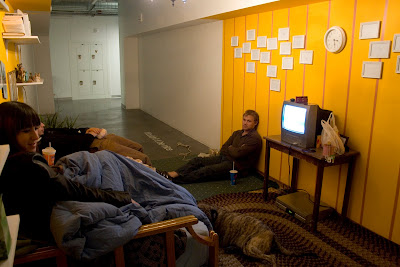
In Wouldn't it be nice if everything was the way it's supposed to be? I created a space and posed a question. I am interested in intimacy and personal spaces like bathrooms and bedrooms as part of that investigation. With this installation, however, I worked intuitively, not fully understanding the room as I made it. I didn't even fully understand the text on the floor as I wrote it, or the video of the ocean; I just knew they belonged there.

I set out to make a bedroom that would make me happy, and hopefully make others happy as well. I wanted to initiate interaction with the viewer through the text and objects. I wanted to work in a corridor so that the viewer is confronted with the space and can pass through it, almost like a ghost, and decide whether or not they want to stay awhile. Or even decide if they want to use the alternate hallway next time.

For me, the work is a lot about a longing for an idyllic world, a sort of world where it is normal to invite people to sleep in your room, a world where tea is always readily available, and a world where kitschy collections of woodland creatures abound. Through the video of the ocean, the houseplant, and the owl and deer figurines, I reference a sort of perversion of the natural: something is removed from it source and brought indoors in a bittersweet way: I love watching the video of the ocean or sitting near the plant, but I would rather be at the actual ocean. Inside, it becomes static.

Whether the room is an empathetic joke to someone that feels like they live at school, an oasis between classes, or a bizarre curiosity, I want the space to produce thoughts surrounding home, privacy, displacement, and this institution. I hope to make more rooms in the future where they don't belong, re-contextualizing this private space.

I have loved seeing the interaction: someone added an owl to my collection, and we are now friends. Someone else made my bed and washed all the mugs for me. Someone else (potentially) stole a mug. Someone else borrowed a book. Someone watched me sleep and someone took photos of me sleeping. Someone else left a note. Someone stored some objects in the room for safe keeping. Someone moved the plant to give it a bit more sunlight. Wouldn't it be nice if everything was the way it's supposed to be?

Wednesday, September 29, 2010

Mein Kinder


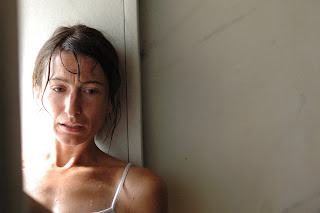
This piece began out of admiration of the space and the proximity that I have held to it thus far this semester. I do not think many people use this room to shower, It is very old and at first sight a bit creepy. I have grown very fond of it and found myself wanting to become part of the space. I feel an intense sense of loss in the space and was drawn to the holocaust because of the nature of the room and shower set up. As I spent time in the space and listened to what the space needed I felt as if there was a ghost who was searching for her children and who died long ago but could not find peace with out finding her children. It is a piece of struggle and loss. I have experienced loss in a long drawn out manner on multiple occasions and have had to watch intense suffering and struggle occur in others who knew that they were dying or losing something very important to them. During these experiences the body begins to react in an almost ghost like behavior and starts to go into automatic pilot where nothing else matters but "mein kinder" or whatever the loss may be for each person. There is a moment that occurs prior to the loss and this moment is very interesting to me. It has a sense of intense fear and also a beginning of one giving into the loss and allowing acceptance to occur. This moment can be felt over and over again as I experienced in this piece. However I was stuck in this moment for the desire to live and save my children was too strong to allow me to completely die and therefore I became a ghost tortured in her own existence. Unable to give into the realization of the loss and move forward I became stuck in the loss but never fully able to experience the loss therefore I was stuck in the moment before the loss.

Monday, September 27, 2010

conflicting perceptions 2 experiment


conflicting perception 2 experiment

This piece was meant to be the “sequel” to the first performance, conflicting perception
Overall, for this altered perception, I wanted to concentrate on communication and hiding.  How do we know we are always speaking to someone? Is it unconsciously or consciously?  Perhaps, our conversations are just dreams or even hallucinations.    
My intention was to experiment with separating the audience from the performance.  I found that I prefer to incorporate the audience.  Otherwise, I would make sure to disrupt the consciousness that was I unintentionally created in today’s performance.  Overall, I was able to see what to add and take away in my next piece.  It was a good experiment with this idea I wanted to present.  For the book, I thought it would be funny if he was reading a book about consciousness.  I had previously thought of having him read, Kokoro by Natsume Soseki.  
After I watched the video, I can see how the audience would have read Nick and Tara as being parental units because of their posture.  I have some ideas about costumes, so I would like to try that next time in a piece.  I don’t use the theme of family in pieces, so I find it odd that could be interrupted as such.   
Basically, I think the piece was interesting and successful by itself, but I think the next performance of conflicting perceptions 2 needs to be more surreal.  Therefore, I’ll regard this one as the experiment. 

Wednesday, September 22, 2010

Response: Bodily Noises

I cannot say I have ever experienced anything as exotic and fierce as this display of human emotion through bodily noises. This exercise was intense, intensely intense for me if that makes sense. In all honesty I have been on an everlasting rollercoaster of emotions and to hear the production of collective emotional noise surrounding me, not to mention in the dark, was actually quite frightening to me. The way I have been feeling lately- up, down, really down- was no match to the level of emotional burden bestowed upon me. The black space and continuous noises were inescapable. I really didn’t know how to react. I was too scared to react. Eventually I found myself humming a continuous hum, something I concentrated on to escape all the noises that made me so uncomfortable. This was probably one of the first times I have ever tried meditating.

What I realize now is that this experience was something far greater than just standing around in a circle, eyes closed, using the body to create noise. Something happened that is difficult for me to put into words. My emotions were taken from me, I was silenced into nothing, and they came back to attack me.

Tuesday, September 21, 2010

"Labyrinth" by Darwin

This large, cascading web was woven late in the night, under the haze of the fire's eastbound smoke.  Weaving it made me feel timeless.  Hip-pop and drunken slurs drifted through my ears as I dipped over and under, around and and between the five trees.

Usually that kind of crap bothers me:  I hate the injustice of rampant alcohol consumption, I hate the racism behind Hip-pop.  But as I wove, the rhythmic movement of my elbows and fingers soothed me, and I felt wise like the spider that wove the story of reality.  The space that sits quietly to the side of the high-traffic path to campus became a labyrinth of solace.  The blue yarn glowed in the hazy damp air.  Looking out from the inside of the web was like looking through fire: everything was vibrating at a minutely perceptible frequency.

In class, I think some humans felt stimulated by the piece.  I think this owes to the vibrancy of the light blue color, the texture and delicacy of the yarn, and the scale of the web relatively.  I noticed that some felt compelled to look at it from new angles; to try to look up at the sky through it; to use it as a lens through which to renew the world.

We came up with some great ideas that inspire me to continue making large-scale webs.  The integration of sound, possibly in the story of dreams is one idea.  Another is regarding material-- creating something elastic that could be stretched and played with, or a reliably sturdy weave that people could lay on.  Also, wouldn't it be fun to look up into the sky and watch the clouds pass, or snow fall through a big, lofty dream-catcher?

-Darwin

Monday, September 20, 2010

Project 1: In Memory of Fuddlescum Kiki


Does the size of an object really change the viewer’s desire to stare at it?  According to kawaii* (cute) culture from Japan, it does.  The use of kawaii articles is one way I conflict themes.    In Memory of Fuddlescum Kiki, kawaii is visually manifested within the installation, but deviates from its usual message to become the opposite, dark humor. 

The installation was meant to be subtle, but overpowering once the viewer becomes engaged with the piece.  This is the kawaii effect, where “cuteness” has the ability to control the viewer’s gaze.  I meant for the lighting to enhance this experience as the viewer might start to feel awkward with the subject matter of viewing of the deceased. 

Funerals or exhibitions of bodies decorate and celebrate bodies, making them the spectacle.  This topic is not limited to humans, but also includes pets.  I find there is always a curiosity towards the experience that I wanted to explore.  In regard to previous experience, I have to ask myself: is this a subconscious desire to remain young or merely a sarcastic representation of the past?  I find that the connection with this curiosity remains even with artificial or “unreal” objects.  I regret that I can’t replace Kiki, but I have no desire to fix it either.      

Dark humor and sarcasm, conflicting themes, and influence from Japanese culture are constant themes within my work.  In addition to this, how can the better understanding of our brain function help us understand ourselves?  Or how far are we able to analyze our subconscious to know what force is in control?  Perhaps, our brains are far beyond our understanding and control.  In the end, we are left with subtle clues, such as the kawaii effect to realize that we are the ones at the mercy of our brain’s function.

In the future, I plan to explore lighting and the color of spaces when I display this work.  Also, I want to explore repetition by creating several other similar pieces through different characters or various funeral scenes with the only one character.  I think I would still use the same “shoe box” format.     

*A subculture psychologically relating back to traumatic effects of atomic bombings and expresses the desire to remain young.  Also, considered a part of Japan’s national identity of harmony/love, cute culture manifests itself into prefectural and government mascots.  

Sunday, September 19, 2010

"Pink Tacos" by Paula Tsiftilis


Pink taco, beaver or axe wound are all slang terms that have been used to describe the vagina. I find it especially interesting , how the term "pink taco"in our culture can be associated with the vagina. I see humor, as well as a degrading side to this, since a complex female reproductive organ can be related to a food, something that is thoughtlessly desired and consumed.

Lately, I have been thinking about the male/female binary and exploring the suffocating influence of social systems upon sexual identity. The objects I create represent the daily experiences of these social constructions, and through layering or dissecting these forms and experiences I discover hidden lives. Here, I have created these delicate objects which suggest a sexual form, and put them on display, for the potential to be critiqued or even consumed.

After shaping the tacos and letting them become firm, I dipped them in pink house paint. In class i had displayed them on top of a vanity mirror, but here I have them on a gold tray which can slightly change the meaning. I thought about the advice I got and altered the piece by placing a silky flowered pattern fabric on the table, instead of the canvas. I feel this was a good change, but I believe there is an even better fabric to suit this installation. I imagine the final fabric to be a dark silky purple with a floral print, that is long enough to touch the floor. I also started drawing on the tacos, to further explore hidden layers. This is definitely a piece that i will be thinking on ways to improve throughout the semester and I want to continue working with the image of a pink taco throughout a series. I usually create hybrid forms that are neither male nor female (or sometimes both), but at the risk of looking like a feminist, I am currently fascinated by the female anatomy and its relationship to consumption and humor.

Eventually, I am interested in creating these small sculptures in an edible form.

learning disability


With this piece I desired to re-create my initial struggle with learning the drums when I was 19. I had an incredibly difficult time getting my limbs to move independently and in synch with one another. It took about a month just to get the most basic 4/4 beat to even sound like that was what I was trying to do. I remember my instructor’s vehement frustration with my inability to just get it together. I remember not even wanting to make eye contact with him. It’s not like I wasn’t trying, I just really struggled with it. Being asked if I have a learning disability is the most offensive well-meaning thing anyone has ever said to me.

I wanted the tapes to be an extension of each of my limbs that play different parts of the drum set (high hat, snare, kick). He used to tell me to practice for 15 mins each day so the duration of the piece was supposed to be like a practice session even though it was about 6 mins short of that. I wanted to mimic the frustration of not only myself but also my instructors. My intentions aren’t to provoke or annoy but simply to share in the frustration of something that was an incredibly difficult/impossible task for me to get my grasp on. But, don’t let it seem as though I didn’t think the possibility for annoyance wasn’t possible. I didn’t think the noises would be annoying but rather the process of watching me try to synch all three would be cumbersome and perhaps empathetic.

I think telling the audience to stand may have been a mistake. I did want you/them to feel somewhat authoritative (looking down upon someone struggling with something) but commanding them to stand I think disrupted any sense of hierarchy.

Tuesday, September 14, 2010

"It's so boring here without you" by Adam Milner


I love this bench. I affectionately call it my office because I can often be found working on it, as I have no better space in the building to work. I enjoy seeing each person walk in and out the front doors, spy on who uses the elevator to go the second floor, and greet people as they emerge from the basement to gain a moment of cellphone reception.

It's so boring here without you
is based on the idea of a sterile, harsh, angular space becoming warm as people fill it. On the first day back to classes I decorated the space and made tea and cookies for whoever wanted to join me for a moment on the bench. I occupied it from 9 to 5 with the exception of our class time. This text was inspired by that event on some level. It speaks to loneliness and a longing for human interaction and proximity.

The text was meant to be both personal and universal. I was hoping the meaning would change depending on who was occupying the space. At moments, the text seemed to be from the artist, at times it came from the person sitting beneath it, and at other times it came from the wood itself. To whom it is speaking also varied throughout it's existence.

I wish it could have stayed installed longer, and I would like to continue this idea both in this space as well as in other areas around campus and the city.